

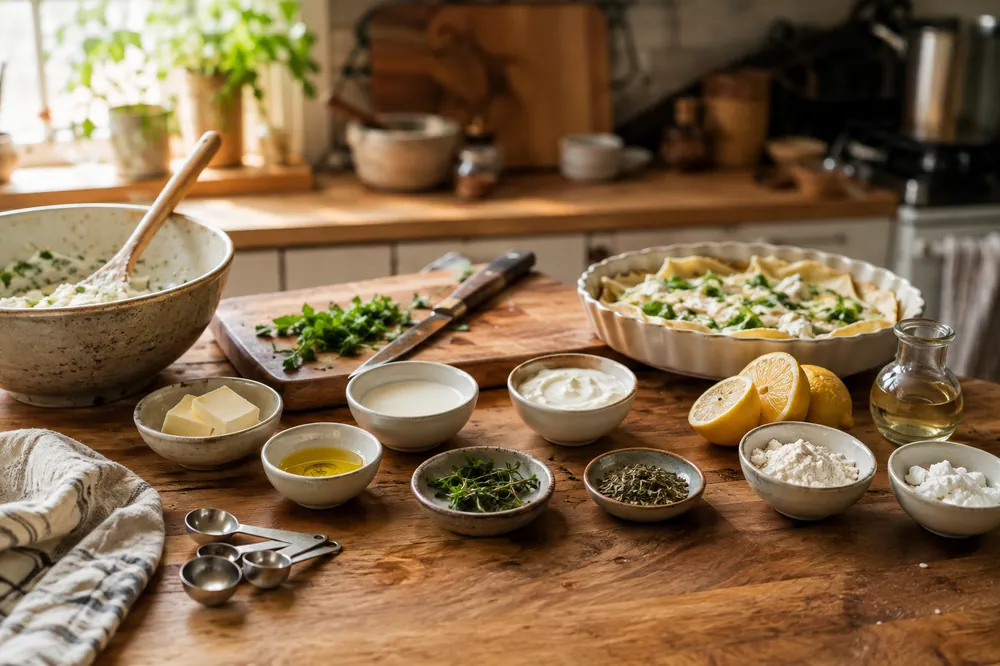
I used to think ingredient substitutions were mostly about finding a direct replacement: no buttermilk, use milk; no brown sugar, use white sugar; no fresh herbs, use dried.
Sometimes it really is that simple.
But the longer I’ve cooked, the more I’ve realized that successful substitutions have less to do with memorizing a giant list of swaps and more to do with understanding what an ingredient is actually doing in the recipe.
Is it there for flavor? Fat? Moisture? Acidity? Structure? Thickening? Sweetness?
Once I know that, I can usually work out whether a substitution will be harmless, noticeable, or likely to ruin the dish altogether.
That distinction matters. Swapping parsley for cilantro in a garnish is very different from replacing flour in a cake. One changes the flavor. The other can change the entire structure of the recipe.
So rather than giving you an endless substitution chart and leaving it at that, I want to explain how I actually think about substitutions in my own kitchen.
Once you understand the logic, you’ll be much better equipped to improvise when the fridge is half empty, accommodate dietary needs, or simply avoid running to the store for one missing ingredient.
Start by Asking What the Ingredient Does
Before replacing anything, I ask myself one simple question:
What job is this ingredient doing?
Most ingredients serve one or more of a few basic purposes:
- adding flavor
- adding sweetness
- providing acidity
- supplying fat
- adding moisture
- creating structure
- thickening
- helping something rise
- binding ingredients together
- adding texture
- providing color or garnish
This is the most useful substitution habit I’ve learned.
If an ingredient is primarily there for flavor, I’m usually comfortable improvising. If it controls the chemistry or structure of the dish, I’m much more careful.
Take lemon juice as an example.
If a recipe calls for lemon juice in a salad dressing, lime juice or a mild vinegar will often work perfectly well because I’m mainly trying to provide acidity.
But if lemon juice is being combined with baking soda in a cake, that acidity is also contributing to the chemical reaction that makes the cake rise. Now the substitution has to behave similarly, not just taste similar.
That is why context matters so much.
Know Which Recipes Are Forgiving
Some recipes practically invite substitutions.
Soups, stews, stir-fries, salads, pasta dishes, curries, casseroles and many sauces can usually handle quite a bit of improvisation.
If I’m making vegetable soup and don’t have celery, I’m not worried. I can add more carrot, some fennel, leek or another vegetable instead.
If I’m making a stir-fry and the recipe calls for broccoli but I have green beans, that is rarely a problem.
Baking is different.
Cakes, cookies, breads, pastries and custards rely much more heavily on specific ratios and chemical reactions. Flour absorbs moisture. Eggs bind and provide structure. Sugar does more than sweeten. Butter influences texture. Baking soda and baking powder control rising.
That doesn’t mean you can’t substitute ingredients when baking. You absolutely can.
I just treat baking substitutions as more technical than cooking substitutions.
As a general rule, the more precise the recipe, the more cautious I am about changing it.
Substitute by Function, Not Just by Flavor
The easiest substitutions are ingredients that perform roughly the same job.
If I need acidity, I look for another acidic ingredient.
If I need fat, I look for another fat.
If I need moisture, I look for something with a similar water content.
This sounds obvious, but it prevents a lot of bad substitutions.
For example, yogurt and sour cream are often interchangeable because both provide moisture, acidity and fat.
Olive oil and melted butter can sometimes substitute for one another because both contribute fat, although the final flavor and texture will be different.
Cornstarch and flour can both thicken sauces, but they behave differently and aren’t used in equal quantities.
The goal isn’t always to find an identical ingredient. Often there isn’t one.
I’m simply looking for something that can perform the same essential function without creating a new problem.
How to Substitute Dairy Products
Dairy is one of the categories I substitute most often because there are usually several workable alternatives.
Milk
For most everyday cooking, one type of milk can replace another without much trouble.
Whole milk is richer than low-fat milk, but in soups, sauces, mashed potatoes and many batters, the difference is manageable.
Plant-based milks can also work well, especially unsweetened varieties.
I pay attention to flavor here. Unsweetened oat milk is quite neutral, while coconut milk can noticeably change a dish.
For savory recipes, I avoid sweetened or strongly flavored plant milks unless that flavor makes sense.
Buttermilk
If I need buttermilk and don’t have it, I usually make a quick substitute.
For every 1 cup of buttermilk, I can use approximately:
1 cup milk + 1 tablespoon lemon juice or white vinegar
I mix them together and leave the mixture for about 5 to 10 minutes.
It won’t become exactly like cultured buttermilk, but it provides the acidity that many recipes need.
Plain yogurt thinned with a little milk is another very good option.
Heavy Cream
For soups and sauces, half-and-half or milk combined with a little butter can often stand in for heavy cream.
The result will usually be less rich.
Coconut cream is another possibility when its flavor suits the recipe.
Where I become more cautious is whipped cream. If the cream needs to whip and hold its shape, lower-fat substitutes generally won’t behave the same way.
Sour Cream
Plain Greek yogurt is probably my favorite sour cream substitute.
It has a similar acidity and thickness, and I use it frequently in dips, sauces, baked potatoes and even some baking recipes.
Regular plain yogurt can work too, although it contains more water.
Butter
Butter can often be replaced with oil in cooking.
For sautéing vegetables, roasting or greasing a pan, I rarely worry about an exact conversion.
Baking requires more thought because butter contains both fat and water and also behaves differently depending on whether it is melted, softened or creamed.
As a rough starting point, I use slightly less oil than the amount of butter called for rather than replacing it one-for-one.
And I expect the texture and flavor to change somewhat.
How to Substitute Eggs
Egg substitutions depend heavily on why the eggs are there.
Eggs can provide:
- binding
- moisture
- richness
- structure
- leavening
That makes them one of the trickier ingredients to replace.
For simple baked goods such as muffins, pancakes or quick breads, common substitutes for one egg include:
- about ¼ cup unsweetened applesauce
- about ¼ cup mashed banana
- about ¼ cup plain yogurt
- 1 tablespoon ground flaxseed mixed with 3 tablespoons water
I particularly like flaxseed mixed with water when I need binding.
Applesauce and banana provide moisture but also affect flavor and sweetness.
The more eggs a recipe contains, the less comfortable I am replacing all of them casually.
Replacing one egg in a batch of muffins is one thing. Replacing six eggs in a custard or soufflé is an entirely different challenge because eggs are fundamental to the structure of those dishes.
How to Substitute Flour and Other Thickeners
Flour substitutions are another area where context matters enormously.
Thickening Sauces
If flour is simply being used to thicken a sauce or gravy, I have plenty of options.
Cornstarch is one of the easiest.
As a rough guide, I usually start with about half as much cornstarch as flour.
Instead of adding cornstarch directly to a hot liquid, I mix it with a small amount of cold water first to create a slurry. Then I stir that into the sauce.
Arrowroot and potato starch can also work as thickeners.
Baking
Replacing flour in baking is much more complicated because flour provides structure.
All-purpose flour and bread flour can sometimes be substituted for each other, but the protein differences may change the texture.
Cake flour has less protein and creates a softer result.
Whole-wheat flour absorbs more liquid and produces a denser texture.
Gluten-free flours can behave very differently from wheat flour, so I generally prefer a tested gluten-free recipe or a commercial gluten-free flour blend designed for one-to-one substitution rather than improvising with a single flour.
This is one area where I don’t assume that two ingredients that look similar will behave similarly.
How to Substitute Sugar and Other Sweeteners
Sugar is another ingredient that does more than its name suggests.
In baking, sugar affects:
- sweetness
- moisture
- browning
- spread
- tenderness
- texture
That is why reducing or replacing sugar can change much more than the flavor.
White and Brown Sugar
White sugar can usually replace brown sugar in many recipes, and vice versa, using approximately the same quantity.
The result won’t be identical.
Brown sugar contains molasses, which provides moisture and a deeper flavor. Cookies made with more brown sugar tend to be softer and chewier, while white sugar often produces a crisper result.
If I need brown sugar and only have white sugar, I can make a simple version by mixing white sugar with molasses.
Honey and Maple Syrup
Liquid sweeteners such as honey and maple syrup are not perfect one-to-one substitutes for granulated sugar because they add additional liquid.
In sauces, marinades and dressings, I substitute them quite freely.
In baking, I’m more cautious because replacing dry sugar with a liquid sweetener changes the balance of the recipe.
If I’m baking something where texture matters, I’d rather use a tested conversion than guess.
How to Substitute Oils and Cooking Fats
For everyday cooking, fats are generally easy to swap.
Olive oil, avocado oil, vegetable oil, sunflower oil and other neutral cooking oils can often replace one another.
What matters most to me is:
- flavor
- cooking temperature
- whether the fat needs to stay solid
If I’m making a vinaigrette, the flavor of the oil matters quite a lot.
If I’m frying or roasting at higher temperatures, I care more about whether the oil is suitable for that heat.
And if a recipe depends on a fat being solid at room temperature—certain pastries, frostings and baked goods, for example—switching to a liquid oil can dramatically change the result.
Again, the function matters more than the ingredient name.
How to Substitute Vinegar and Citrus
Acid is one of the easiest things to adjust in savory cooking.
If a recipe calls for lemon juice and I don’t have any, I might use:
- lime juice
- white wine vinegar
- apple cider vinegar
- rice vinegar
The same works in reverse.
What I don’t do is assume that every acid tastes the same.
Balsamic vinegar is acidic, but it’s also sweet and strongly flavored.
Distilled white vinegar can be much sharper than lemon juice.
Rice vinegar is often milder.
So I usually substitute gradually and taste as I go.
If a recipe calls for 2 tablespoons of lemon juice, I might start with 1 tablespoon of vinegar and decide from there rather than automatically adding the full amount.
How to Substitute Fresh and Dried Herbs
Fresh and dried herbs are often interchangeable, but the amounts shouldn’t be identical.
Dried herbs are more concentrated.
My usual starting point is:
1 teaspoon dried herbs for every 1 tablespoon fresh herbs.
That’s roughly a 1:3 ratio.
There are exceptions.
Some herbs, such as oregano, thyme and rosemary, dry very well.
Others, such as parsley, cilantro and basil, lose much of their fresh character when dried.
If fresh basil is one of the main flavors in a dish, dried basil will technically work, but it won’t give me the same result.
When herbs are just providing background flavor, I’m much less concerned.
How to Substitute Spices
Spice substitutions are usually forgiving as long as I understand the flavor I’m trying to create.
If I’m missing one spice from a mixture, I sometimes simply leave it out rather than replace it with something inappropriate.
That’s an underrated option.
Not every ingredient requires a substitute.
If I’m missing cardamom from a spice blend, adding extra cumin isn’t necessarily going to improve things. Sometimes the dish will be better with no cardamom than with a completely unrelated flavor.
When substituting spices, I think in terms of flavor families.
For example:
- cinnamon, nutmeg, allspice and cloves share warm aromatic characteristics
- cumin and coriander often appear together in savory spice blends
- smoked paprika can sometimes replace some of the smokiness provided by other ingredients
- chili flakes, cayenne and fresh chilies can all provide heat, although at very different intensities
I always start with less when substituting something spicy or especially strong.
It’s easy to add more. It’s much harder to take it back out.
How to Substitute Fresh Garlic and Onion
Garlic and onion are easy to work around in most savory dishes.
If I don’t have fresh garlic, I’ll often use garlic powder.
A rough conversion I use is:
⅛ teaspoon garlic powder for 1 clove of garlic.
The flavors aren’t identical. Fresh garlic tends to taste sharper and more aromatic, while garlic powder is more evenly distributed through the dish.
The same principle applies to onion.
Onion powder can provide onion flavor, but it can’t reproduce the texture or volume of sautéed onion.
If the recipe uses onion as a major vegetable component, I’d rather substitute shallots, leeks or another aromatic vegetable.
How to Substitute Stock or Broth
If a recipe calls for stock and I’m out, water is often perfectly acceptable.
This is one of those substitutions people sometimes overthink.
I use water and then compensate with additional seasoning.
Depending on the dish, I might add:
- salt
- herbs
- garlic
- onion
- soy sauce
- miso
- bouillon
If the stock is only one part of a strongly flavored stew or sauce, water may make surprisingly little difference.
If I’m making something where stock is the main flavor—such as a delicate broth-based soup—then the substitution becomes much more noticeable.
How to Substitute Wine in Cooking
When wine is used in cooking, it usually contributes acidity, sweetness and complexity.
If I don’t want to use it or simply don’t have any, I often use stock or water combined with a little acidity.
For white wine, I might use:
stock + a small splash of lemon juice or white wine vinegar
For red wine, stock with a little red wine vinegar can work.
Grape juice can sometimes be useful, but I use it cautiously because it can make savory dishes too sweet.
I wouldn’t expect these alternatives to taste exactly like wine. The goal is to replace some of the balance the wine was contributing.
How to Substitute Breadcrumbs
Breadcrumbs are usually easy to replace when they’re being used as a coating or binder.
Depending on the recipe, I’ve used:
- crushed crackers
- crushed cornflakes
- rolled oats
- panko
- finely ground nuts
For meatballs or meatloaf, oats can work surprisingly well.
For crispy coatings, crushed crackers or cereal can be excellent.
As always, I think about texture first.
If I want crunch, I choose something crunchy.
If I need binding, I choose something absorbent.
How to Substitute Soy Sauce
Soy sauce contributes much more than salt.
It provides saltiness, umami and fermented flavor.
Depending on the reason for the substitution, alternatives can include:
- tamari
- coconut aminos
- fish sauce
- Worcestershire sauce
These aren’t necessarily equal substitutes.
Fish sauce is much stronger, for example, so I use less.
If sodium or gluten is the reason for changing the ingredient, I also check the label rather than assuming the alternative solves the problem.
How to Substitute Ingredients When You Need More or Less Moisture
One of the easiest ways to accidentally ruin a recipe is to ignore water content.
Two ingredients can seem interchangeable while containing very different amounts of moisture.
Fresh spinach and frozen spinach are a good example.
Frozen spinach releases a lot of water, so I usually thaw it and squeeze it thoroughly before adding it to recipes such as quiche, lasagna or dips.
The same issue comes up with vegetables, fruit, yogurt and different types of cheese.
Whenever I substitute a wetter ingredient, I ask whether I should:
- drain it
- reduce another liquid
- cook it longer
- add a little more thickener
And if the replacement is drier, I consider whether the recipe needs additional liquid.
This small adjustment makes substitutions far more reliable.
Don’t Forget About Texture
Flavor gets most of the attention when people talk about substitutions, but texture is often just as important.
Imagine replacing crunchy celery in a salad with cooked zucchini.
The flavor might be perfectly acceptable, but the texture is completely different.
When I substitute vegetables or other solid ingredients, I try to match characteristics such as:
- crunchy versus soft
- watery versus dry
- creamy versus firm
- chewy versus tender
- smooth versus coarse
If I need crunch, I might substitute cucumber, radish, fennel or bell pepper depending on the dish.
If I need something creamy, avocado, yogurt, soft cheese or mashed beans might work.
The better I match both flavor and texture, the less noticeable the substitution becomes.
Consider How the Substitute Will Cook
I also think about cooking time.
If I replace carrots with zucchini in a roasted vegetable dish, I shouldn’t necessarily cook them for the same amount of time.
Carrots take considerably longer to soften.
Likewise, replacing chicken thighs with chicken breast may require adjusting cooking time because breast meat is leaner and easier to overcook.
A substitution isn’t always just an ingredient change.
Sometimes it also requires changing:
- temperature
- cooking time
- liquid quantity
- seasoning
- preparation method
That’s completely normal.
Taste as You Go Whenever You Can
For savory cooking, tasting is my biggest safety net.
If I’m substituting vinegar, spices, sweeteners, stock, sauces or herbs, I rarely add the full amount immediately.
I add some.
I taste.
Then I decide whether the dish needs more.
This is especially useful when ingredients vary greatly in intensity.
One brand of soy sauce may be much saltier than another. One lemon may be more acidic than the next. Fresh chilies can vary dramatically in heat.
Recipe quantities are useful guides, but your tongue is ultimately a better judge of whether the dish is balanced.
Baking obviously gives you fewer opportunities to taste and adjust once the ingredients are mixed, which is another reason I make more conservative substitutions there.
Make One Major Substitution at a Time
One lesson I’ve learned from experimenting is that multiple substitutions can compound.
Changing one ingredient is usually easy to evaluate.
Changing flour, sugar, eggs and fat simultaneously turns the recipe into something entirely different.
If it fails, I have no idea which substitution caused the problem.
When possible, I prefer making one significant change at a time.
That way I learn something from the result.
Maybe Greek yogurt works perfectly instead of sour cream.
Maybe oil makes the muffins softer than butter.
Maybe the new flour makes the cake too dense.
The next time I make the recipe, I know what to adjust.
That’s how substitution becomes a cooking skill rather than guesswork.
Know When Not to Substitute
This is probably the most important rule of all.
Sometimes the correct substitute is no substitute.
If an ingredient defines the dish, replacing it may defeat the point.
I wouldn’t casually replace the Parmesan in a dish where Parmesan is the dominant flavor, or swap out most of the eggs in a custard and expect the same result.
The same applies to ingredients involved in important chemical reactions.
I’m especially cautious with:
- baking soda
- baking powder
- yeast
- gelatin
- flour in baking
- large quantities of eggs
- chocolate in chocolate-based desserts
- specialty ingredients that define a particular cuisine or dish
You can often redesign the recipe around an alternative, but that’s different from making a simple substitution.
Sometimes it’s better to choose another recipe built around the ingredients you actually have.
My Simple Ingredient Substitution Checklist
When I’m standing in the kitchen wondering whether I can swap one ingredient for another, this is essentially the thought process I use:
- What is the missing ingredient doing?
Flavor, fat, moisture, acidity, structure, thickening, binding or something else? - Is this a forgiving recipe?
Soup and stir-fry give me much more freedom than pastry or cake. - Does the substitute perform the same function?
Similar taste isn’t enough if the ingredient is doing an important structural job. - Will the texture change?
I consider crunchiness, thickness, moisture and firmness. - Will the cooking time change?
Different ingredients may soften, brown or cook at different speeds. - Should I start with less?
Especially with acids, salt, spices, chilies and strong sauces. - Can I taste and adjust?
If yes, I take advantage of it. - Is the ingredient essential to the identity of the dish?
If it is, I think twice before replacing it.
Substitution Is Really About Understanding How Food Works
I don’t keep an enormous ingredient-substitution chart taped inside my kitchen cabinet.
There are simply too many ingredients and too many recipes for any chart to cover every situation.
What has helped me far more is understanding the basic roles ingredients play.
Once I know that yogurt can provide acidity and moisture, I can see why it might replace sour cream.
Once I know cornstarch is primarily there to thicken a sauce, I can look for another thickener.
Once I realize an herb is mainly providing background flavor, I know I have room to improvise.
And once I understand that eggs or flour are responsible for the structure of a cake, I know not to swap them casually.
That’s really the skill I’m trying to build whenever I substitute ingredients.
I’m not trying to reproduce a recipe perfectly with completely different ingredients.
I’m trying to understand what matters, preserve the important parts, and adapt everything else.
And once you get comfortable doing that, recipes stop feeling quite so rigid.
They become what I’ve always found them most useful as: a starting point for making good food with what I actually have in the kitchen.