

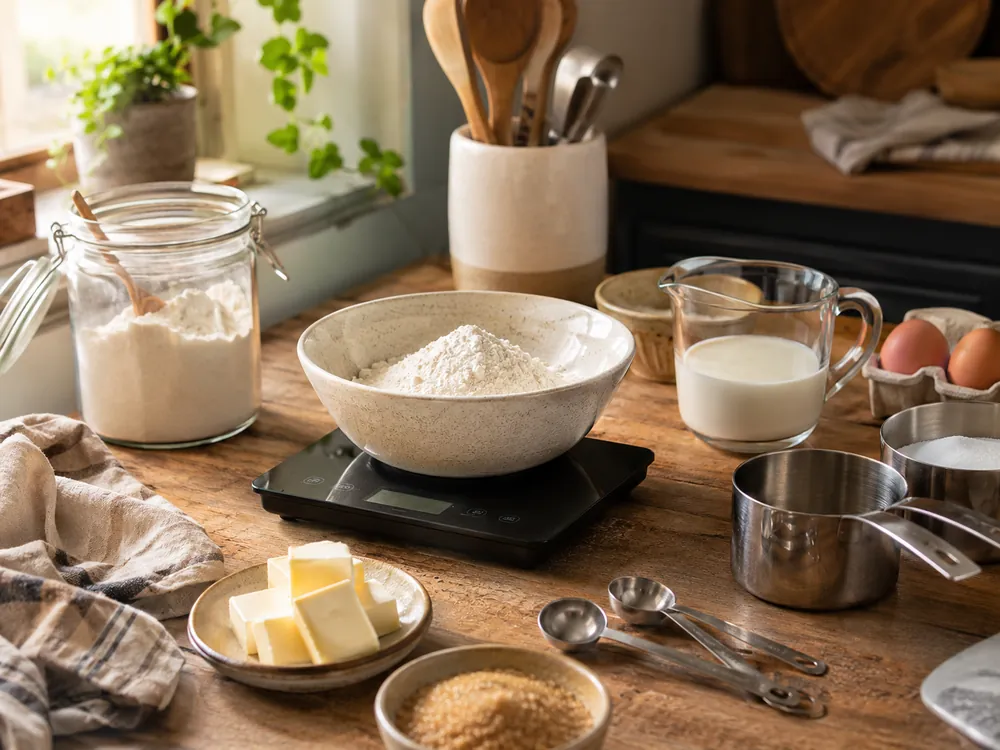
I used to think measuring ingredients was one of the least interesting parts of cooking. A cup was a cup, a tablespoon was a tablespoon, and if a recipe used grams instead of ounces, I could always look up the conversion.
Then I started cooking from recipes written in different countries.
Suddenly, a “cup” wasn’t always the same cup. Ounces could mean weight or volume. A tablespoon wasn’t necessarily 15 milliliters everywhere. Flour measured by volume could vary dramatically depending on how I filled the cup. And converting 200 grams of flour into cups turned out to be very different from converting 200 grams of sugar into cups.
None of this means cooking needs to become an exercise in mathematics. Quite the opposite. Once I understood a few basic principles, measurements became much easier to deal with.
The most important thing I’ve learned is that not all measurements are interchangeable. Weight, volume, temperature, and ingredient-specific conversions are different things, and knowing which one you’re dealing with prevents most mistakes.
This guide covers the measurement and conversion knowledge I actually find useful in the kitchen.
The Two Main Ways We Measure Ingredients: Weight and Volume
Almost every ingredient in a recipe is measured either by weight or by volume.
Weight tells us how heavy something is. Common units include:
- Grams (g)
- Kilograms (kg)
- Ounces (oz)
- Pounds (lb)
Volume tells us how much space something occupies. Common units include:
- Teaspoons (tsp)
- Tablespoons (tbsp)
- Cups
- Fluid ounces (fl oz)
- Milliliters (ml)
- Liters (L)
This distinction seems obvious, but it’s at the heart of a lot of conversion confusion.
A gram is a measurement of weight. A milliliter is a measurement of volume. They measure two completely different things.
With water, the numbers happen to line up very conveniently: 1 milliliter of water weighs approximately 1 gram. But that does not mean 100 ml of every ingredient weighs 100 grams.
One hundred milliliters of oil weighs less than 100 grams. One hundred milliliters of honey weighs considerably more.
That’s why I never treat grams and milliliters as automatically interchangeable unless I know the ingredient.
Why I Prefer Measuring by Weight When Possible
If I have the choice, particularly when baking, I’ll almost always use a digital kitchen scale.
Weight is simply more consistent.
Imagine measuring one cup of flour. I could gently spoon flour into the cup and level it off. I could scoop the cup directly into the bag. I could shake the cup. I could accidentally compact the flour.
Every method can result in a slightly different amount.
Put 120 grams of flour on a scale, on the other hand, and it’s 120 grams every time.
For forgiving dishes such as soups, stews, sauces, and stir-fries, the difference often doesn’t matter much. If I add slightly more onion than a recipe calls for, dinner isn’t ruined.
Baking is different. Ratios between flour, liquid, sugar, fat, and leavening can have a noticeable effect on the final result.
That’s why you’ll see many professional bakers—and increasingly many home-cooking recipes—use grams.
The Metric System in the Kitchen
The metric system is wonderfully straightforward once you’re used to it.
The main units I use are:
| Measurement | Equivalent |
|---|---|
| 1,000 milligrams | 1 gram |
| 1,000 grams | 1 kilogram |
| 1,000 milliliters | 1 liter |
For everyday cooking, you’ll mostly encounter grams and milliliters.
A recipe might call for:
- 250 g flour
- 100 g sugar
- 30 g butter
- 500 ml stock
- 1 L water
There’s very little mental arithmetic involved.
One kilogram is simply 1,000 grams, and one liter is 1,000 milliliters.
Understanding US Cups, Tablespoons, and Teaspoons
American recipes commonly measure many ingredients by volume using cups, tablespoons, and teaspoons.
The basic US relationships are:
| US measurement | Equivalent |
|---|---|
| 3 teaspoons | 1 tablespoon |
| 16 tablespoons | 1 cup |
| 8 fluid ounces | 1 cup |
| 2 cups | 1 pint |
| 2 pints | 1 quart |
| 4 quarts | 1 gallon |
For practical kitchen conversions, I usually work with these approximate metric equivalents:
| US measurement | Metric equivalent |
|---|---|
| 1 teaspoon | 5 ml |
| 1 tablespoon | 15 ml |
| 1/4 cup | 60 ml |
| 1/3 cup | 80 ml |
| 1/2 cup | 120 ml |
| 2/3 cup | 160 ml |
| 3/4 cup | 180 ml |
| 1 cup | 240 ml |
You’ll sometimes see a US cup rounded to 240 ml and sometimes to about 237 ml. For normal cooking, 240 ml is the much more practical number.
That tiny difference rarely matters outside very precise applications.
A Cup Is Not Always the Same Size
This was one of the first things that surprised me when I started using recipes from around the world.
“Cup” sounds universal. It isn’t.
A standard US cup is about 237 ml, commonly rounded to 240 ml for cooking. A metric cup is 250 ml.
Australian recipes commonly use the 250 ml metric cup.
That means blindly converting every cup to 250 ml can introduce a small error when using an American recipe.
Most of the time, the difference isn’t disastrous. But across several cups—or in a sensitive baking recipe—it can start to matter.
If a recipe looks particularly precise, I check where it was published before making assumptions about its cup measurements.
Tablespoons Can Vary Too
Tablespoons have a similar problem.
In the US and most countries using metric kitchen measurements:
1 tablespoon ≈ 15 ml
But in Australia, a standard tablespoon is traditionally:
1 Australian tablespoon = 20 ml
That’s a surprisingly large difference.
If an Australian recipe calls for three tablespoons of an ingredient, that’s 60 ml rather than the 45 ml I’d get using a standard 15 ml tablespoon.
For something such as chopped herbs, the difference may barely matter. For concentrated ingredients, liquids, or baking, it can.
It’s another reason I like recipes that provide metric measurements alongside spoon measurements.
Ounces and Fluid Ounces Are Not the Same Thing
This is probably the kitchen measurement distinction I see cause the most confusion.
An ounce (oz) measures weight.
A fluid ounce (fl oz) measures volume.
They are not interchangeable.
For weight:
1 ounce ≈ 28.35 grams
For US liquid volume:
1 US fluid ounce ≈ 29.6 ml
Those numbers look similar, which makes the terminology even more confusing.
So if a recipe calls for:
8 oz cheese
that’s a weight measurement.
If it calls for:
8 fl oz milk
that’s a volume measurement.
Eight US fluid ounces also happens to equal one US cup.
Whenever I see “oz” in a recipe, I check whether the ingredient is being measured by weight or volume before converting anything.
Useful Weight Conversions
These are the conversions I find most useful when moving between metric and imperial recipes:
| Imperial | Metric |
|---|---|
| 1 oz | 28.35 g |
| 2 oz | 57 g |
| 4 oz | 113 g |
| 8 oz | 227 g |
| 16 oz | 454 g |
| 1 lb | 454 g |
| 2.2 lb | 1 kg |
For everyday cooking, I don’t worry about extreme precision unless the recipe calls for it.
For example, I would happily think of half a pound as roughly 225 grams rather than calculating 226.8 grams.
Cooking is usually more forgiving than the conversion calculator makes it appear.
Why You Can’t Convert Grams to Cups Without Knowing the Ingredient
This is the conversion mistake I would most like to eliminate from kitchens.
There is no universal conversion from grams to cups.
Grams measure weight. Cups measure volume.
To convert between them, you need to know the density of the ingredient.
A cup of flour doesn’t weigh the same as a cup of sugar. A cup of butter doesn’t weigh the same as a cup of honey.
Typical approximate weights for one US cup are:
| Ingredient | Approximate weight per US cup |
|---|---|
| All-purpose flour | 120–125 g |
| Granulated sugar | 200 g |
| Brown sugar, packed | 210–220 g |
| Powdered sugar | 115–120 g |
| Butter | 227 g |
| Honey | 335–340 g |
| Rolled oats | 80–90 g |
| Uncooked long-grain rice | 185–200 g |
You’ll notice that the numbers vary enormously.
So if someone asks, “How many cups is 200 grams?” the correct answer is: 200 grams of what?
Two hundred grams of granulated sugar is roughly a cup.
Two hundred grams of flour is closer to 1⅔ cups.
Same weight, very different volume.
How I Measure Dry Ingredients Correctly
When I’m following a recipe that uses cups rather than grams, the measuring technique matters.
For flour, I prefer the spoon-and-level method.
I loosen the flour slightly, spoon it into the measuring cup without packing it down, and then run the flat edge of a knife across the top.
What I try not to do is plunge the measuring cup directly into the flour bag and scoop. That tends to compress the flour and can result in considerably more flour than the recipe intended.
Sugar behaves differently.
Granulated sugar naturally settles more consistently, so I can usually scoop it and level it.
Brown sugar is often specifically listed as “packed brown sugar.” In that case, I press it firmly into the measuring cup.
Powdered sugar may be listed as sifted or unsifted, which can also change its volume.
This is one reason measurements that look straightforward can still require reading the wording of the recipe carefully.
How I Measure Liquids
For larger quantities of liquid, I use a transparent liquid measuring jug rather than a dry measuring cup.
I put it on a level surface, pour in the liquid, and check the measurement at eye level.
Looking down at the cup from above can make the liquid appear to reach a different measurement line than it actually does.
For small quantities, measuring spoons are easier.
One practical rule I’ve adopted is to measure sticky ingredients such as honey, syrup, or molasses after measuring oil when a recipe includes both. The thin coating of oil helps the sticky ingredient slide out of the measuring spoon or cup much more cleanly.
It’s a tiny trick, but it’s one I use constantly.
When Measuring Spoons Matter—and When They Don’t
I own proper measuring spoons because the teaspoons and tablespoons in my cutlery drawer aren’t standardized.
One household teaspoon might hold considerably more than another.
When a recipe says:
- 1 teaspoon baking powder
- 1/2 teaspoon salt
- 1/4 teaspoon baking soda
I use measuring spoons.
For something casual, like a spoonful of olive oil going into a pan, I’m much less concerned.
The more an ingredient affects the chemistry of the recipe, the more carefully I measure it.
Baking soda, baking powder, yeast, gelatin, salt, and strong spices are good examples of ingredients where seemingly small differences can matter.
A Pinch, Dash, and Other Informal Measurements
Not every kitchen measurement is supposed to be precise.
Recipes often use terms such as:
- Pinch
- Dash
- Splash
- Drizzle
- Handful
- Knob
These aren’t standardized scientific units.
A pinch is literally roughly the amount I can pick up between my thumb and forefinger.
A splash of liquid is a small pour.
A drizzle is a thin stream.
A handful depends partly on the cook’s hand—which tells you how approximate the instruction is supposed to be.
When I see language like this, I don’t reach for measuring equipment. The recipe is telling me that precision isn’t important.
Part of becoming comfortable in the kitchen is learning when to measure carefully and when not to.
Converting Fahrenheit and Celsius
Oven temperatures are another common source of confusion, especially when I move between American and European recipes.
The exact formulas are:
Celsius to Fahrenheit:
°F = (°C × 9/5) + 32
Fahrenheit to Celsius:
°C = (°F − 32) × 5/9
I almost never calculate those formulas while cooking.
These are the conversions I actually remember or refer to:
| Celsius | Fahrenheit |
|---|---|
| 100°C | 212°F |
| 120°C | 250°F |
| 140°C | 285°F |
| 150°C | 300°F |
| 160°C | 320°F |
| 180°C | 350°F |
| 190°C | 375°F |
| 200°C | 400°F |
| 220°C | 425°F |
| 230°C | 450°F |
| 240°C | 465°F |
You don’t need to hit the mathematically exact converted temperature. Ovens themselves cycle above and below their set temperature anyway, and recipes generally use convenient temperature increments.
Fan Ovens Need Their Own Adjustment
There’s another variable that’s easy to overlook when converting oven temperatures: whether the recipe means a conventional oven or a fan-assisted oven.
A fan oven circulates hot air, generally cooking food more efficiently.
As a rough rule, I reduce a conventional oven temperature by about 20°C when using a fan oven.
So:
200°C conventional → about 180°C fan
180°C conventional → about 160°C fan
I still follow the recipe’s own fan-oven instruction whenever one is provided, because the ideal adjustment varies somewhat with the dish.
And just as importantly, I start checking the food itself rather than treating the stated cooking time as absolute.
Kitchen Scales: One of the Simplest Upgrades You Can Make
A basic digital kitchen scale is one of the few pieces of kitchen equipment I think almost everyone can benefit from.
I put my bowl on the scale, press the tare or zero button, and the display resets to zero.
Then I add the first ingredient.
I can zero the scale again before adding the next one.
This means I can often measure an entire recipe directly into one bowl without dirtying multiple measuring cups.
It also makes awkward ingredients much easier to measure. Instead of trying to pack peanut butter, butter, honey, or yogurt perfectly into a measuring cup and then scrape it all back out, I can simply weigh the amount I need.
Once I started doing this regularly, measuring ingredients actually became faster.
Should You Convert a Recipe or Use Its Original Measurements?
Whenever possible, I prefer to use the measurements the recipe author originally provided.
If the recipe is written in grams, I use grams.
If it’s a well-tested American recipe written in cups, I’ll usually use the cup measurements.
Every conversion introduces the possibility of rounding.
Converting one measurement isn’t usually a problem. Converting every ingredient in a complicated baking recipe can gradually change the ratios.
If both metric and imperial measurements are supplied by the recipe author, even better. I usually choose the metric version.
What I try to avoid is repeatedly converting a recipe back and forth between measurement systems.
Don’t Confuse Weight Ounces With Package Sizes
There’s another situation that catches people out: ingredient packaging.
A recipe may ask for 8 ounces of pasta, while the package is labeled in grams.
That’s straightforward:
8 oz × 28.35 ≈ 227 g.
I’d simply use roughly 225–230 grams.
But packages themselves aren’t measuring tools.
If a recipe says “one 14-ounce can of tomatoes,” for example, it’s usually referring to a common product size rather than expecting you to weigh tomatoes with laboratory precision.
If my local supermarket sells a 400 g can instead of a 14 oz / 397 g can, I’m using the 400 g can.
Those three grams are not going to change dinner.
Knowing when not to worry about a conversion is just as useful as knowing how to calculate one.
Measuring by Precision, Not Habit
Over time, I’ve started thinking of ingredients in three broad categories.
Some ingredients deserve accurate measurement. Flour, leavening agents, gelatin, yeast, and baking ingredients often fall into this group.
Some ingredients need reasonable measurement but allow flexibility. Rice, pasta, stock, butter, and cooking liquids are good examples.
And some ingredients I measure largely by taste. Herbs, pepper, garlic, olive oil, lemon juice, and many seasonings often end up in this category.
The recipe still gives me a starting point, but I don’t treat every number as equally sacred.
That’s an important transition in cooking. Measurements are there to help you reproduce a result—not to prevent you from using judgment.
Quick Kitchen Conversion Chart
These are the basic conversions worth keeping close by:
Volume
| Measurement | Equivalent |
|---|---|
| 1 tsp | 5 ml |
| 3 tsp | 1 tbsp |
| 1 tbsp | 15 ml |
| 4 tbsp | 1/4 cup |
| 8 tbsp | 1/2 cup |
| 16 tbsp | 1 cup |
| 1/4 US cup | ~60 ml |
| 1/3 US cup | ~80 ml |
| 1/2 US cup | ~120 ml |
| 3/4 US cup | ~180 ml |
| 1 US cup | ~240 ml |
| 1 metric cup | 250 ml |
| 1 L | 1,000 ml |
Weight
| Measurement | Equivalent |
|---|---|
| 1 oz | 28.35 g |
| 4 oz | ~113 g |
| 8 oz | ~227 g |
| 16 oz | ~454 g |
| 1 lb | ~454 g |
| 1 kg | ~2.2 lb |
Common Oven Temperatures
| Celsius | Fahrenheit |
|---|---|
| 150°C | 300°F |
| 160°C | 320°F |
| 180°C | 350°F |
| 190°C | 375°F |
| 200°C | 400°F |
| 220°C | 425°F |
| 230°C | 450°F |
The Measurement Rules I Actually Remember
Despite all the tables and conversions in this guide, I don’t carry most of them around in my head.
The handful of rules I genuinely remember are enough for almost everything:
1 teaspoon is about 5 ml.
1 tablespoon is about 15 ml.
1 US cup is about 240 ml.
1 ounce is about 28 grams.
1 pound is about 454 grams.
1 kilogram is about 2.2 pounds.
And perhaps most importantly:
You cannot reliably convert grams to cups without knowing the ingredient.
Once those basics clicked for me, recipes from different countries stopped feeling like they were written in different languages.
And that’s really the goal. You don’t need to memorize an enormous conversion chart to become a competent cook. You just need to understand what the numbers are measuring, know which conversions are safe to make, and recognize when precision actually matters.
Do that, and measurements become what they should have been all along: a useful tool rather than another thing to worry about in the kitchen.