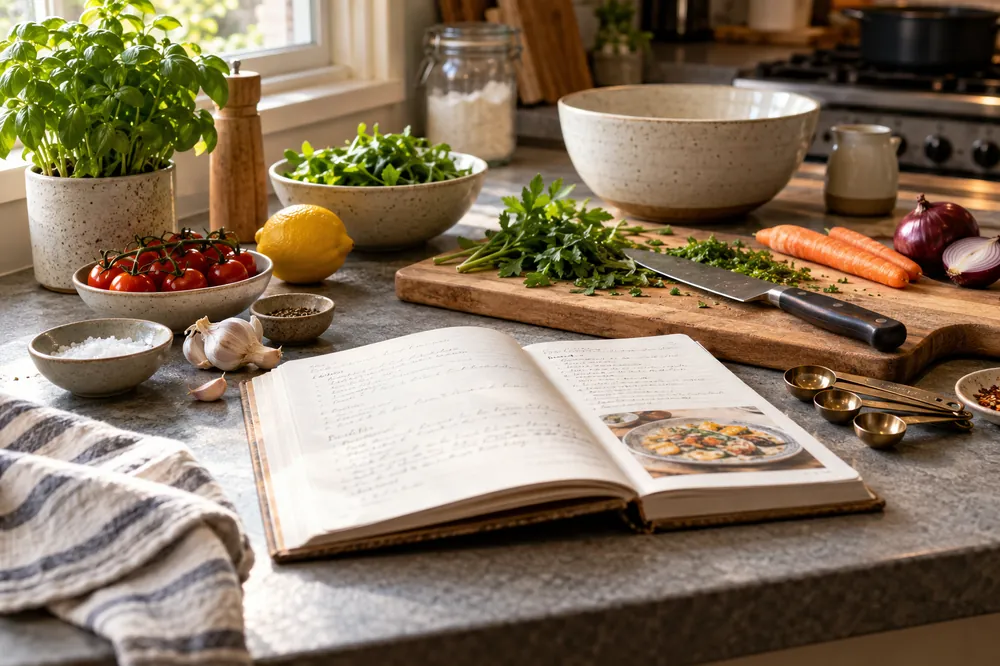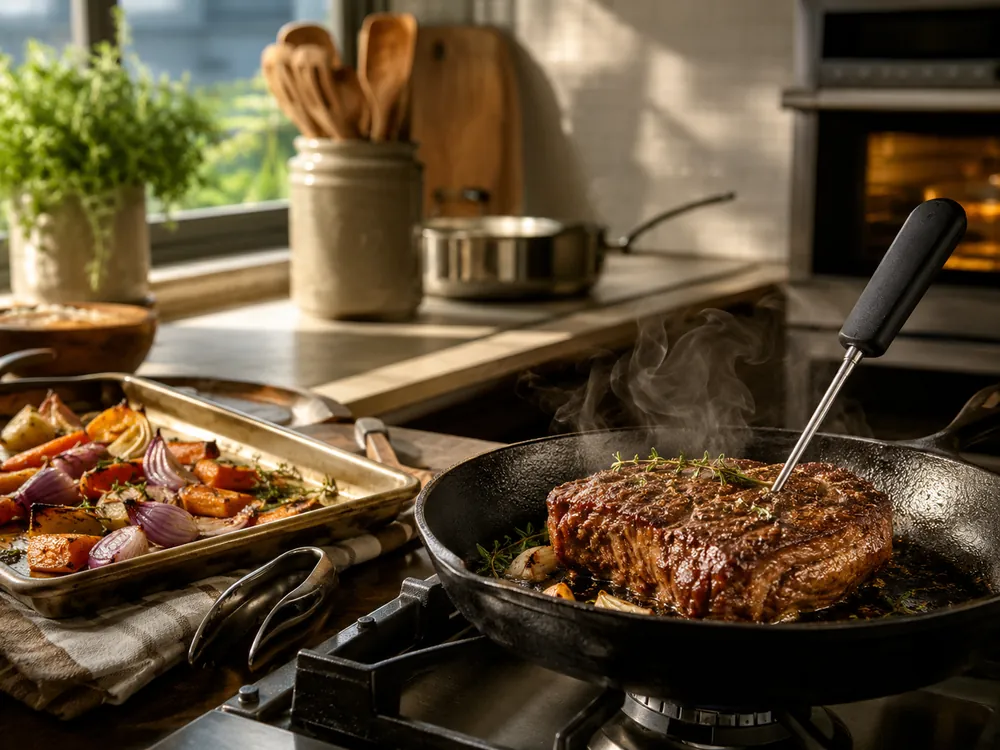

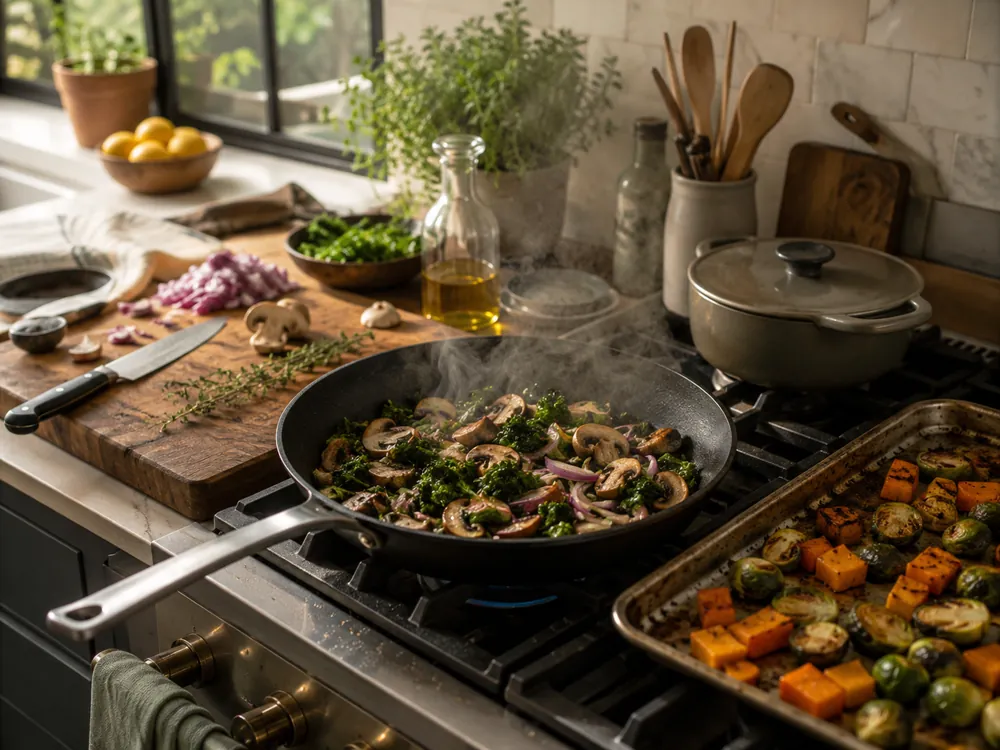
When I first started cooking regularly, I thought becoming a better cook meant learning more recipes. The more dishes I could make, the better I must be getting.
Over time, I realized that wasn’t really how it worked.
The biggest improvement came when I stopped thinking so much about individual recipes and started paying attention to the techniques behind them. Once I understood how to properly brown something in a pan, how to control heat, when to add salt, or why a sauce had become too thin, suddenly hundreds of recipes became easier.
That’s the useful thing about cooking techniques: they transfer from one dish to another.
You don’t need culinary-school training or a drawer full of specialized equipment. Most good home cooking comes down to a relatively small collection of skills that you use again and again.
These are the ones I think every home cook should know.
1. Learn Basic Knife Skills
Knife skills sound more intimidating than they actually are. You don’t need to chop an onion at restaurant speed or turn vegetables into perfectly identical cubes.
What matters much more is being able to cut food safely, comfortably, and reasonably evenly.
Even pieces cook at roughly the same rate. If half your potatoes are one centimeter thick and the other half are three centimeters thick, some will be falling apart while others are still hard in the middle. The same applies to onions, carrots, chicken, and almost anything else you’re cooking.
The first habit I learned was to stabilize whatever I’m cutting. Flat surfaces are safer than round ones, so I’ll often cut a vegetable in half first and place the flat side against the board.
I also use the basic “claw” grip with my guiding hand: fingertips curled slightly inward while the side of the knife moves against my knuckles. It feels awkward at first, but it keeps fingertips out of the blade’s path.
A sharp knife matters too. Counterintuitively, I’ve always found a dull knife more unnerving because you have to apply more force and it is more likely to slip.
You don’t need dozens of knives. A decent chef’s knife, a small paring knife, and perhaps a serrated bread knife will handle almost everything in a normal home kitchen.
Focus on control before speed. Speed comes naturally later.
2. Get Into the Habit of Mise en Place
Mise en place is simply the practice of getting things ready before you start cooking.
I used to consider this unnecessary fuss. Why chop everything beforehand when I could just prepare ingredients while the food was cooking?
Sometimes you can. But I’ve also learned how quickly that strategy falls apart when onions are browning faster than expected while you’re still trying to peel garlic.
Before I cook, I now try to scan the recipe and identify anything that will need to happen quickly. I’ll chop vegetables, open tins, measure spices, and place frequently used ingredients somewhere accessible.
This doesn’t mean you need twenty tiny glass bowls lined up like a television cooking show. I usually leave ingredients on the chopping board or group things together on a plate.
The real purpose is simply to avoid surprises.
Mise en place becomes especially important with fast cooking methods such as stir-frying, sautéing, and making pan sauces. Once the pan is hot, you often don’t have much time to stop and prepare the next ingredient.
Cooking becomes noticeably calmer when everything you need is within reach.
3. Understand How to Control Heat
If I could teach a new cook only one thing, heat control would be near the top of the list.
A stove dial isn’t really an instruction. “Medium-high” on one stove can behave very differently from medium-high on another. Different pans respond differently too.
Instead of blindly following the dial, I’ve learned to pay attention to what the food is actually doing.
If garlic is turning brown within seconds, the pan is probably too hot. If mushrooms are sitting in a pool of their own liquid without browning, the heat may be too low or the pan too crowded. If oil starts smoking heavily, that’s another clear signal.
I think of heat as something I’m constantly adjusting rather than a setting I choose once at the beginning.
High heat is useful when I want rapid browning. Moderate heat gives me more control. Low heat is useful when something needs time to gently cook through without burning.
And sometimes the best adjustment is simply taking the pan off the burner for a moment.
Recipes can tell you approximately how much heat to use. Learning to recognize what the food looks, sounds, and smells like tells you much more.
4. Season Food as You Cook
One of the easiest differences to notice between bland food and properly cooked food is seasoning.
For most everyday cooking, that primarily means salt.
I prefer to season gradually rather than dump all the salt in at the end. A little salt added while onions are cooking, another small amount when liquid goes into the pan, and a final adjustment before serving usually gives me much more control.
This also gives the seasoning time to become part of the dish rather than simply sitting on its surface.
The important exception is when ingredients are going to reduce significantly. Stocks, sauces, soups, and braises can become much saltier as water evaporates, so I tend to be conservative early on and make the final adjustment later.
And seasoning isn’t only about salt.
If something tastes flat even though it seems salty enough, I’ll often reach for acidity instead. A squeeze of lemon, splash of vinegar, spoonful of yogurt, or even a little mustard can completely wake up a dish.
Rich food sometimes needs acidity. Bitter food may need a little sweetness. Heavy dishes often benefit from fresh herbs or something crisp.
Good seasoning is really about balance.
Taste whenever it is safe to do so. That habit alone will teach you more about cooking than memorizing precise quantities ever could.
5. Learn How to Sauté Properly
Sautéing is one of the techniques I probably use most often.
At its simplest, it means cooking food relatively quickly in a small amount of fat over moderate to fairly high heat.
I use it for onions, mushrooms, vegetables, chicken, shrimp, and countless other ingredients.
The biggest lesson I’ve learned is not to overcrowd the pan.
Food contains water. When too much food goes into a pan at once, that water turns to steam faster than it can escape. Instead of browning, everything starts steaming in its own moisture.
That’s why mushrooms or pieces of meat sometimes turn pale and watery instead of developing that appetizing golden surface.
If necessary, I cook in batches.
I also let the pan heat before adding ingredients and resist the urge to constantly move everything around. Browning requires contact with the hot surface. If I’m stirring every two seconds, I’m often preventing that from happening.
A little patience usually produces much better results.
6. Know How to Sear and Brown Food
Browning is responsible for an enormous amount of flavor in cooking.
When the surface of meat, vegetables, bread, or other foods becomes deeply golden or brown, a collection of chemical reactions known broadly as the Maillard reaction creates hundreds of new flavor and aroma compounds.
You don’t need to understand the chemistry to take advantage of it.
What matters is heat, a reasonably dry surface, and enough contact with the pan.
If I’m searing meat, I’ll usually pat the exterior dry first. Moisture has to evaporate before meaningful browning can happen, so a wet surface works against you.
I also wait until the pan is properly hot and then leave the food alone for a while.
This was surprisingly difficult for me when I was learning. There is always a temptation to lift a steak or piece of chicken every few seconds to see what’s happening underneath.
Usually, it just needs time.
Another useful thing to know is that browned doesn’t mean burnt. You’re looking for a deep golden or brown crust, not a blackened surface or a pan full of smoking oil.
Once you get comfortable with browning, very simple ingredients start tasting much more interesting.
7. Learn the Difference Between Boiling and Simmering
For years, I treated “boil” and “simmer” as almost interchangeable instructions.
They aren’t.
A full boil is vigorous. Large bubbles rapidly break across the surface and the liquid is moving constantly.
A simmer is gentler. You’ll see smaller bubbles rising steadily, but the liquid isn’t violently agitated.
That difference matters.
Boiling is useful when cooking things such as pasta or when you want water to evaporate quickly. Gentle simmering is usually better for soups, sauces, stews, and foods that need time to become tender.
I’ve ruined more than one sauce by leaving it at an aggressive boil and assuming faster must be better.
It isn’t.
A hard boil can make meat tough, break delicate ingredients apart, reduce liquid too quickly, or turn a smooth sauce into something greasy.
When a recipe tells me to “bring to a boil, then reduce to a simmer,” I now take that second instruction seriously.
8. Master Roasting
Roasting is one of my favorite techniques because the oven does most of the work.
Vegetables are an obvious example. Toss them with a little oil and seasoning, spread them across a tray, and roast them at a relatively high temperature until browned and tender.
But there are a few details that make a big difference.
Again, overcrowding matters. If vegetables are piled on top of one another, they trap steam. Giving them some space helps their surfaces dry and brown.
The size of the pieces matters too. Smaller pieces cook faster and develop more browned edges. Larger pieces take longer and usually retain more moisture inside.
I also try not to rely too heavily on the cooking time printed in a recipe.
Ovens vary. Ingredients vary. A tray of carrots may be beautifully caramelized after 25 minutes one day and need another ten minutes the next.
I use the recipe’s time as a guide, then look at the food.
If it isn’t browned and tender yet, it isn’t done just because the timer says it should be.
9. Understand Braising
Braising is one of those cooking techniques that sounds sophisticated but is actually wonderfully forgiving.
The basic idea is simple: brown an ingredient first, then cook it slowly with some liquid.
It’s particularly useful for tougher cuts of meat because long, gentle cooking gradually breaks down connective tissue and turns something initially chewy into something tender.
I usually start by browning the meat well, remove it from the pot, cook aromatic vegetables such as onions and carrots, then add liquid and return the meat.
The liquid doesn’t normally need to completely cover everything. Braising is somewhere between dry roasting and full submersion.
Then I let time do the work.
One of the most useful lessons I’ve learned from braising is that tough meat isn’t always overcooked. Sometimes it simply hasn’t cooked long enough.
If a braised piece of meat is still stubbornly tough, another 30 or 60 minutes may transform it.
It’s one of the best techniques to learn if you want to turn relatively inexpensive ingredients into deeply flavored meals.
10. Learn to Deglaze a Pan
After browning meat or vegetables, you’ll often see dark brown bits stuck to the bottom of the pan.
Don’t immediately scrub them away.
Those bits are called fond, and they’re packed with flavor.
Deglazing simply means adding liquid to the hot pan and using it to loosen those browned pieces.
I might use stock, wine, water, cider, or another liquid depending on what I’m cooking. Once it hits the hot pan, I’ll scrape the bottom gently with a wooden spoon or spatula.
Within seconds, what looked like a dirty pan starts becoming the foundation of a sauce.
From there, I can reduce the liquid, add butter, cream, mustard, herbs, or other ingredients and turn it into a quick pan sauce.
It’s one of those techniques that feels disproportionately impressive compared with how easy it actually is.
Better still, you’re using flavor that would otherwise have gone down the sink.
11. Understand Reduction
Reducing a liquid simply means simmering or boiling it so some of the water evaporates.
As the water disappears, flavors become more concentrated and the liquid usually thickens.
I use reduction constantly without necessarily thinking about it: concentrating a tomato sauce, thickening a pan sauce, intensifying stock, or simmering cream until it coats a spoon.
The important thing is to remember that everything else becomes concentrated too.
That includes salt, sugar, acidity, and spices.
If I know a sauce is going to reduce substantially, I avoid seasoning it too aggressively at the beginning.
And as the liquid becomes more concentrated, I watch it more carefully. A sauce can spend ten minutes looking almost unchanged and then suddenly become much thicker during the final few minutes.
Reduction is another reason why cooking by appearance and taste is often more reliable than cooking strictly by the clock.
12. Learn How Emulsions Work
Some of the most familiar sauces in cooking are emulsions: mixtures of two liquids that normally don’t want to stay together.
Oil and water are the classic example.
Mayonnaise is an emulsion. So is vinaigrette when it’s properly combined. Butter sauces and many creamy dressings rely on the same principle.
You don’t need to become a food scientist, but understanding the basic idea is incredibly useful.
If I whisk oil slowly into vinegar or another water-based liquid, I can temporarily disperse tiny droplets of oil throughout the mixture. Ingredients such as mustard or egg yolk help stabilize those droplets and keep everything together.
Temperature matters with some emulsions too. Add butter to a screaming-hot sauce and it may separate into an oily mess. Swirl cold butter gradually into a warm but not aggressively boiling sauce and you can get something glossy and smooth.
Once you understand what an emulsion is, mysterious instructions such as “slowly drizzle in the oil while whisking” suddenly make sense.
13. Learn to Cook Pasta Properly
Pasta is simple enough that it’s easy to stop thinking about technique.
But a few small habits make a surprising difference.
I use plenty of boiling water and salt it before adding the pasta. Once the pasta goes in, I stir it fairly quickly so pieces don’t stick together.
More importantly, I try to finish pasta with its sauce, not treat the two as completely separate components.
I’ll often move the pasta into the sauce slightly before it’s completely cooked, then add a splash of the pasta cooking water.
That cloudy water contains starch, which helps loosen the sauce while also helping it cling to the pasta.
Then I’ll toss everything together for another minute or two.
The result feels much more integrated than simply placing plain pasta on a plate and spooning sauce over the top.
It’s a small technique, but once I started doing it, I rarely went back.
14. Know How to Tell When Food Is Done
Recipes often give precise cooking times because they’re useful starting points.
But food doesn’t own a stopwatch.
A chicken breast can be thicker than the one used by the recipe writer. Potatoes vary enormously in size. Your oven may run hotter than mine. Your pan may hold heat differently.
Learning to judge doneness is therefore one of the most valuable cooking skills you can develop.
For meat, I strongly recommend using an instant-read thermometer. It’s inexpensive, removes a lot of guesswork, and is particularly useful when food safety matters.
For vegetables, I often use the tip of a knife or fork. For cakes, I’ll look at texture and use the appropriate doneness test. For sauces, I’ll look at consistency.
Eventually you start collecting visual and sensory clues.
Onions become translucent. Mushrooms shrink and brown. Fish turns opaque and flakes. Bread develops a deeply colored crust. Sauces begin to coat the back of a spoon.
Timers are useful.
Your senses are better.
15. Rest Meat Before Cutting It
One of the easiest ways to undo a beautifully cooked piece of meat is to cut into it immediately.
I’ve done it plenty of times because when something comes out of the oven or pan smelling fantastic, waiting feels unnecessary.
But resting helps.
As meat cooks, heat moves from the outside toward the center. Even after you remove it from the pan or oven, its internal temperature can continue rising for a while — something known as carryover cooking.
Allowing the meat to rest also gives its internal juices time to redistribute.
If you cut into a large piece of meat immediately, you’ll often see a flood of juice run across the cutting board. Give it some time and more of that moisture stays where you actually want it: inside the meat.
A small piece might only need a few minutes. A large roast needs much longer.
I generally rest meat loosely rather than wrapping it tightly, which can trap steam and soften the browned exterior.
16. Learn to Taste and Adjust
If there is one habit that ties almost every cooking technique together, it’s this one.
Taste your food.
Not only at the end. Taste during cooking whenever it’s safe and practical.
When I taste something, I’m usually asking myself a few simple questions:
- Does it need more salt?
- Does it feel too rich?
- Is it missing acidity?
- Is it too acidic?
- Does it need sweetness?
- Does it need more heat or spice?
- Is the flavor intense enough?
- Is the texture where I want it?
The answer isn’t always “add more seasoning.”
Sometimes a soup tastes weak because it needs to reduce. A sauce may taste heavy because it needs lemon juice. A stew may be salty enough but still need fresh herbs. A tomato sauce may simply need another 20 minutes of cooking.
This is where cooking gradually becomes less about following instructions and more about making decisions.
And that’s really the goal.
Technique Matters More Than Memorizing Recipes
You don’t need to master all of these techniques before you’re allowed to consider yourself a capable cook.
Most of them develop almost accidentally through repetition.
The first time you sear something, you’ll probably check it too often. At some point you’ll overcrowd a pan. You’ll oversalt a sauce that was supposed to reduce. You’ll cut into a piece of meat too soon because you don’t want to wait.
I’ve done all of those things.
But each mistake teaches you what to look for the next time.
That’s why I think learning techniques is so much more useful than trying to memorize dozens of recipes. Once you understand why food behaves the way it does, recipes stop feeling like rigid sets of instructions.
You start recognizing patterns.
You know when a pan needs more heat. You know when something needs another minute before you turn it. You know when a sauce needs acidity rather than salt. You know when to trust the recipe and when to trust what you’re seeing in front of you.
That’s the point where cooking becomes much more enjoyable.
You’re no longer just following recipes.
You’re learning how to cook.