
For a long time, I thought reading a recipe meant starting at the top and following the instructions one line at a time.
That works until step four casually tells you to “add the softened butter,” your butter is still rock-hard in the fridge, and the onions you were supposed to have finely diced are still sitting whole on the counter.
One of the biggest improvements I made as a home cook had nothing to do with learning a new technique. I simply got better at reading the recipe before I started cooking.
A good recipe is more than a list of instructions. It’s a small plan for how a dish comes together. Once you learn how to read that plan, cooking becomes calmer, mistakes become easier to avoid, and you start to understand why recipes are written the way they are.
Here’s the approach I use whenever I cook something unfamiliar.
1. Read the Entire Recipe Before You Start
This is the single most useful habit I can recommend to a new cook.
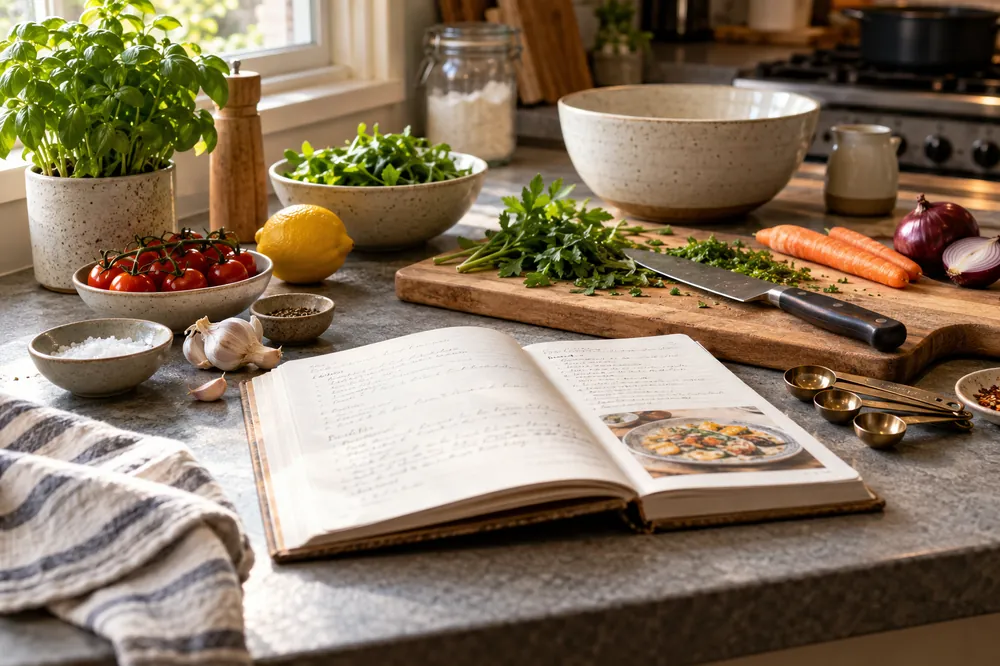
Before I take out a pan, turn on the oven, or start chopping anything, I read the recipe from beginning to end.
Not skim it. Actually read it.
I’m looking for a few things:
- How long will this really take?
- Are there ingredients that need to be softened, chilled, thawed, soaked, or brought to room temperature?
- Does anything need to marinate?
- Will I need to preheat the oven?
- Are ingredients added quickly one after another?
- Is there a long resting, rising, cooling, or simmering period?
- Do I need any equipment I might not have?
Recipe titles can be misleading when it comes to time. A dish advertised as a “30-minute dinner” might require cooked rice, softened butter, or pre-marinated chicken. That doesn’t necessarily make the recipe bad, but it does mean I want to know about it before I begin.
Reading ahead also lets me understand the rhythm of the recipe. Some dishes have plenty of downtime. Others move very quickly once the cooking starts.
A stir-fry, for example, isn’t something I want to prep as I go. Once the pan is hot, ingredients may be going in every 30 seconds. I want everything chopped and waiting beside the stove.
A stew is much more forgiving. Once it reaches the simmering stage, I might have an hour with very little to do.
Knowing that beforehand makes a surprisingly big difference.
2. Start With the Ingredient List
After reading the whole recipe, I go through the ingredients again.
First, I check whether I actually have everything.
It sounds obvious, but this is where I’ve prevented plenty of abandoned dinners. There’s nothing quite like discovering halfway through a recipe that the “small amount of tomato paste” you were sure was in the cupboard disappeared three meals ago.
I also pay attention to how the ingredients are written, because the wording often contains instructions.
Consider these:
1 cup walnuts, chopped
and
1 cup chopped walnuts
They aren’t necessarily the same measurement.
In the first version, I measure one cup of walnuts and then chop them. In the second, I chop the walnuts first and then measure one cup.
You’ll see the same pattern with ingredients such as onions, herbs, fruit, cheese, and vegetables.
Other descriptions matter too:
- butter, softened
- butter, melted
- eggs, at room temperature
- onion, finely diced
- garlic, minced
- tomatoes, drained
- flour, sifted
Those aren’t decorative details. They’re part of the recipe.
When I see them, I mentally translate the ingredient list into a small preparation list.
3. Pay Attention to the Order of the Ingredients
Recipe writers usually list ingredients roughly in the order they’re used.
That means the ingredient list can give you an early preview of the cooking process.
If I see olive oil, onion, garlic, tomatoes, stock, and cream listed in that order, I can already make a reasonable guess about how the sauce will develop: oil first, aromatics next, liquid ingredients later, cream toward the end.
Recipes sometimes divide ingredients into groups as well:
For the chicken
For the sauce
For the dressing
To serve
I find these sections particularly useful because they show me the structure of the dish before I even start cooking.
Once you’ve cooked regularly for a while, ingredient lists start feeling less like shopping lists and more like little maps.
4. Understand the Difference Between Prep Time and Total Time
One of the easiest recipe details to misread is the cooking time.
A recipe might say:
Prep time: 15 minutes
Cook time: 30 minutes
That sounds like dinner will be ready in 45 minutes.
But perhaps the dough also has to rest for an hour. Or the meat needs to marinate. Or the finished dish has to cool before you can slice it.
That’s why I care much more about total elapsed time than the headline cooking time.
Whenever I’m planning when to eat, I look through the instructions for words such as:
- rest
- chill
- freeze
- marinate
- soak
- rise
- proof
- cool
- refrigerate
- bring to room temperature
These are often the hidden time commitments in a recipe.
If you’re cooking for guests, they’re especially important. I never want to discover at 7:15 that the dessert I’m hoping to serve at 7:30 needs two hours in the refrigerator.
5. Check the Equipment Before Cooking
Next, I make sure I have the equipment the recipe expects me to use.
Usually this is straightforward: a saucepan, frying pan, baking sheet, knife, and cutting board.
But some recipes rely on more specific equipment:
- food processor
- blender
- stand mixer
- hand mixer
- Dutch oven
- roasting rack
- kitchen thermometer
- fine-mesh sieve
- loaf pan
- springform pan
Pan size matters more than I used to appreciate.
A cake designed for an 8-inch pan may bake very differently in a 10-inch pan. A crowded frying pan may steam food that was supposed to brown. A sauce cooked in an enormous pot may reduce much faster than expected.
You don’t always need the exact equipment specified, but if you’re substituting something, it’s worth thinking about how that change might affect the cooking.
6. Do Your Prep Before the Fast Part Starts
You’ve probably heard the French term mise en place, which basically means having everything in its place.
I don’t believe every home-cooked meal requires twenty tiny bowls lined up like a television cooking show. That often creates more dishes than I want to wash.
But I do believe in preparing ingredients before I reach the part of the recipe where I won’t have time to stop.
If the recipe says:
Add the onion and cook for 3 minutes. Add the garlic and cook for 30 seconds, then immediately add the tomatoes.
I want the garlic minced and the tomatoes opened before that onion hits the pan.
Thirty seconds is not enough time to find a garlic clove, peel it, mince it, locate the can opener, and open the tomatoes.
For slower recipes, I prep more casually. I might chop the next ingredient while the previous one cooks.
The trick is simply to look ahead and ask:
Will I have enough time to prepare the next ingredient while this one is cooking?
If the answer is no, I prep it beforehand.
7. Learn What Recipe Instructions Actually Mean
Recipes often use short cooking terms that carry quite a lot of meaning.
Fortunately, you don’t need to memorize an entire culinary dictionary. A handful of common terms will get you a long way.
Chop
Cut into pieces. Unless the recipe specifies otherwise, perfect uniformity usually isn’t necessary, although similarly sized pieces tend to cook more evenly.
Dice
Cut into relatively small cubes. You may also see finely diced, small dice, or roughly diced.
Mince
Cut very finely. Garlic is probably the ingredient you’ll see minced most often.
Sauté
Cook fairly quickly in a small amount of fat, usually in a frying pan or saucepan.
Simmer
Cook liquid gently, with small bubbles appearing regularly.
This is different from a full boil, where the liquid is moving aggressively.
That distinction matters. A sauce that should gently simmer can reduce too quickly or break apart if it’s violently boiling.
Fold
Combine ingredients gently rather than vigorously stirring them together.
You’ll often see this in baking when you’re trying to preserve air in a mixture.
Cream
Beat ingredients, most commonly butter and sugar, until they’re lighter and fluffy.
Deglaze
Add liquid to a hot pan to loosen the flavorful browned bits stuck to the bottom.
Reduce
Cook a liquid so some of its water evaporates, concentrating the flavor and usually thickening it.
Season to taste
Add salt, pepper, acid, or other seasoning gradually until the dish tastes right to you.
This phrase can feel frustrating when you’re new to cooking because you’re probably following the recipe precisely because you don’t yet know what “right” tastes like.
My approach is simple: add a little, taste, and repeat.
You can always add more seasoning. Removing it is much harder.
8. Treat Cooking Times as Guides, Not Commands
This was one of the harder lessons for me to learn.
If a recipe says:
Cook the onions for 5 minutes, until softened and lightly golden.
The important part isn’t necessarily 5 minutes.
The important part is softened and lightly golden.
Maybe that happens in four minutes on your stove. Maybe it takes eight.
Recipes can’t know the exact strength of your burner, thickness of your pan, temperature of your ingredients, or size of your chopped onion.
That’s why well-written recipes often give you two kinds of information:
Time: about 5 minutes
Visual or physical cue: softened and lightly golden
When the two disagree, I generally trust the physical cue.
The same principle applies to baking, although baking usually requires tighter control.
If a cake recipe says to bake for 30 to 35 minutes until a toothpick inserted into the center comes out clean, I start checking around the suggested time, but the toothpick tells me more than the clock does.
9. Look for Doneness Cues
One of the fastest ways to become a more confident cook is to start noticing how recipes describe doneness.
Food might be ready when it is:
- golden brown
- tender when pierced with a fork
- crisp around the edges
- bubbling
- reduced by half
- thick enough to coat the back of a spoon
- fragrant
- opaque throughout
- easily pulled apart with a fork
These descriptions teach you what the finished stage should actually look and feel like.
Over time, I find myself relying less on timers and more on these cues.
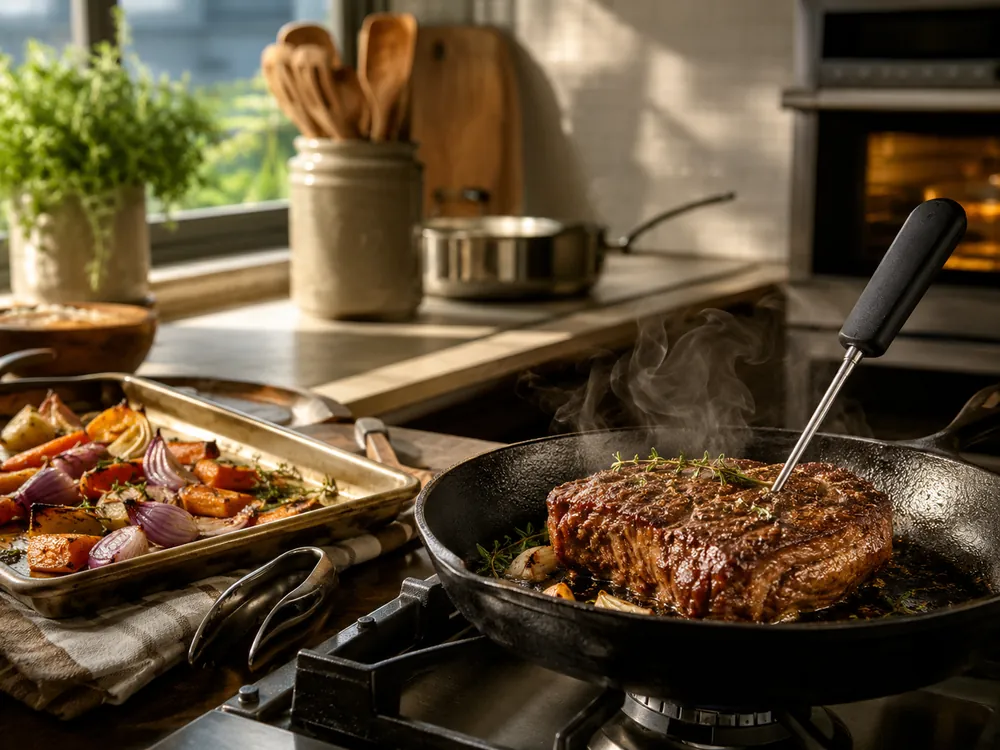
For meat, I prefer using an instant-read thermometer whenever temperature is a reliable indicator of doneness. Guessing based on cooking time alone is much less dependable because the thickness and starting temperature of the meat can vary considerably.
10. Notice Words Like “About,” “Until,” and “As Needed”
These little phrases tell you how much flexibility a recipe allows.
“Cook for about 10 minutes” means 10 minutes is an estimate.
“Cook until golden brown” means appearance matters more than the exact time.
“Add water as needed” means the amount depends on what is happening in your pan.
“Season to taste” means there isn’t one universally correct quantity.
Beginners understandably want recipes to provide exact answers. I did too.
But cooking involves ingredients that vary.
One lemon may produce much more juice than another. Tomatoes vary enormously in sweetness and acidity. Flour absorbs different amounts of water depending on the type, brand, humidity, and how it was measured.
Good recipes give precise measurements where precision matters and sensory cues where judgment matters.
Learning to recognize the difference is a major part of learning to cook.
11. Be Careful With Ingredient Substitutions
I substitute ingredients all the time, but I try to understand what role the ingredient is playing before I replace it.
Sometimes substitutions barely matter.
Don’t have parsley for garnish? The dinner will survive.
Other substitutions can completely change the recipe.
Replacing baking powder with baking soda isn’t a simple one-for-one swap. Changing heavy cream to skim milk will affect richness and often texture. Swapping one type of flour for another can transform a baked recipe.
Before substituting something, I ask:
Is this ingredient mainly providing flavor, or is it doing something structural?
Flavor ingredients generally give you more freedom.
Structural ingredients, particularly in baking, deserve more caution.
When I’m making a recipe for the first time, I also try not to change five things simultaneously. If the result goes wrong, I want some chance of figuring out why.
12. Understand That Baking Recipes Require More Precision
I treat a pasta sauce and a cake very differently.
When I’m cooking savory food, I’m usually comfortable adjusting ingredients as I go. I’ll add another splash of stock, a little extra garlic, less chili, or more lemon juice.
Baking is chemistry with snacks at the end.
Ratios between flour, fat, sugar, liquid, eggs, and leavening agents affect the structure of what you’re making. Seemingly small changes can produce surprisingly large differences.
That’s why I follow baking recipes much more closely, particularly the first time.
If a baking recipe provides measurements by weight, I prefer them. A kitchen scale removes a lot of uncertainty from ingredients such as flour, where one person’s “cup” can contain significantly more than another person’s.
13. Know When You Can Scale a Recipe
Doubling a recipe sounds simple: multiply everything by two.
Often, that’s exactly what you can do.
But not always.
If I’m doubling soup, stew, chili, or a simple sauce, I’m generally comfortable doubling the ingredients and adjusting the seasoning toward the end.
Other recipes require more thought.
Doubling a batch of cookies may require baking several trays rather than putting twice as many cookies on one tray.
Doubling a frying-pan recipe may overcrowd the pan and prevent proper browning.
A larger casserole may need more cooking time.
Seasonings may also not scale perfectly. If I’m doubling a recipe that contains a lot of salt, chili, or strong spices, I often add slightly less than double at first and adjust later.
And when baking, I’m much more careful about changing batch sizes unless I understand how the recipe will respond.
14. Don’t Skip Resting and Cooling Instructions
I used to see resting time as optional dead time.
It often isn’t.
When a recipe tells you to rest meat before slicing, cool a cake before frosting it, let cookie dough chill, or leave bread dough to rise, something useful is happening.
Cut meat immediately and more of its juices may end up on the cutting board.
Frost a warm cake and the frosting may melt.
Slice a loaf of bread straight from the oven and its interior can become gummy.
Chill cookie dough and the cookies may spread differently in the oven.
When a recipe specifically includes a resting stage, I assume there’s a reason for it unless I know otherwise.
15. Taste Whenever It Makes Sense
Recipes can tell you how much salt the writer used.
They can’t tell you exactly how your food tastes.
Ingredients vary, and so do preferences.
That’s why I taste throughout the cooking process whenever it’s safe and practical.
If I’m making a soup or sauce, I’ll usually taste it several times.
I might notice that it needs:
- salt
- acidity
- sweetness
- heat
- richness
- more cooking time
I try not to make enormous adjustments all at once.
A pinch of salt. Stir. Taste.
A squeeze of lemon. Stir. Taste.
A little more chili. Stir. Taste.
This is one of the places where cooking gradually stops feeling like executing instructions and starts feeling like actually cooking.
16. Understand the Recipe’s Sequence
Before I begin, I like to mentally divide the recipe into stages.
A simple pasta sauce might look something like:
- Prep the ingredients.
- Brown the meat.
- Cook the onion and garlic.
- Add tomatoes and seasonings.
- Simmer.
- Cook the pasta.
- Combine and adjust the sauce.
- Finish with cheese and herbs.
Thinking in stages makes longer recipes much easier to follow.
Instead of facing 14 individual instructions, I’m really moving through five or six logical parts.
It also helps me spot problems.
If the pasta takes 10 minutes but the sauce still needs 40 minutes of simmering, I clearly don’t want to start the pasta at the same time as the sauce.
The recipe’s sequence tells me not only what to do, but when each part needs to happen.
17. Watch for Instructions Hidden in the Ingredients
One of the easiest beginner mistakes is missing preparation instructions that appear only in the ingredient list.
Imagine the recipe says:
2 cups cooked rice
That means you need two cups of rice that have already been cooked, not two cups of dry rice that you’re about to cook.
Or:
3 tablespoons butter, melted and cooled
You need to melt the butter and then give it time to cool before using it.
Or:
1 pound chicken, cut into 1-inch pieces
That cutting happens before the chicken reaches the stage where it’s used.
I always scan the ingredient list for these little verbs before starting.
They often reveal half of the prep work.
18. Don’t Assume Every Recipe Is Written Perfectly
This is worth remembering, especially if you cook from the internet.
Sometimes you aren’t the problem. The recipe is.
A measurement may be wrong. An instruction may be unclear. A step may have been accidentally omitted. The cooking time might be unrealistic.
If something seems strange, I stop and think about it rather than blindly continuing.
If a recipe tells me to put garlic into extremely hot oil for five minutes before adding anything else, for example, I know there’s a good chance I’ll end up with burnt garlic.
That’s one reason I like understanding basic cooking techniques rather than treating every recipe as unquestionable.
The more you cook, the better your internal alarm system becomes.
19. Make Notes When You Cook
If I know I’ll probably make a recipe again, I like to remember what I changed.
Maybe it needed another five minutes in my oven.
Maybe I preferred twice the lemon.
Maybe I used less salt.
Maybe the recipe claimed four servings but realistically gave me three.
These small observations make the second attempt much better.
Cooking is surprisingly iterative. A recipe doesn’t have to become “your recipe” because you invented it from scratch. It can become yours because you’ve cooked it enough times to understand exactly how you like it.
The Most Common Recipe-Reading Mistakes
Most mistakes I see beginners make aren’t really failures of cooking ability. They’re failures of preparation.
The most common ones are:
- Starting before reading the entire recipe
- Discovering halfway through that an ingredient is missing
- Not noticing that an ingredient needed advance preparation
- Measuring an ingredient incorrectly because of how the list was worded
- Chopping ingredients while something time-sensitive is already cooking
- Following the stated cooking time instead of checking whether the food is actually done
- Making too many substitutions on the first attempt
- Ignoring resting or cooling periods
- Turning up the heat because something isn’t cooking fast enough
- Forgetting to taste and adjust the seasoning
I’ve made essentially all of these mistakes.
They’re also very easy to prevent once you’re aware of them.
My Routine Before I Cook a New Recipe
These days, when I’m cooking something unfamiliar, my routine is simple.
First, I read the entire recipe.
Then I check that I have the ingredients and equipment.
I look for anything that needs advance preparation: preheating, thawing, marinating, softening, soaking, chilling, or bringing to room temperature.
Next, I prepare whatever needs to be ready before the cooking gets busy.
Finally, I start.
It probably adds two or three minutes before I begin cooking.
It saves considerably more time once I’m in the middle of it.
A Recipe Is a Guide, Not Just a Set of Orders
When you’re first learning to cook, recipes can feel almost like instruction manuals.
Do this.
Wait five minutes.
Add that.
Turn the heat down.
Eventually, though, you start seeing the information underneath the instructions.
You understand why the pan needs to be hot before the food goes in. You recognize why onions are cooked before garlic. You know what a simmer looks like without checking a definition. You can tell that a sauce isn’t ready because it hasn’t reduced enough, even though the timer says it should be.
That’s the point where following recipes becomes much easier.
And strangely enough, it’s also the point where you start needing them less.
If there’s one habit I’d encourage every beginner to adopt, it’s this: read the recipe once before you cook it, then read it again while you cook.
The first read gives you the plan.
The second gets dinner on the table.